
WHALE WATCH
SUNSET WHALE WATCH
ALL DAY WHALE WATCH
SUNSET MUSIC CRUISE
WHALE WATCH
SCIENCE IN THE HARBOR
Field Guides
Explore Our Field Guides
Whether you’re a seasoned marine enthusiast or a first-time whale watcher, our Field Guides are here to enhance your experience. These guides offer insights into the whales, marine life, and ecosystems you’ll encounter on your Dolphin Fleet adventure. Dive in and discover the wonders of the sea.
A Naturalists’s Guide
THE MARINE LIFE OF THE STELLWAGEN BANK NATIONAL MARINE SANCTUARY
Welcome to a whale and marine life adventure!
Artwork by Tessa Morgan. Design by Chelsea Raine
A WEB OF LIFE
Within the waters of the Sanctuary, myriads of tiny plant-life (phytoplankton) and animal plankton (zooplankton) form the basis of an intricate and fragile food web for larger animals including squid, fish, seabirds, and the cetaceans. Cetaceans are mammals and include toothed whales (dolphins and porpoises) and the baleen whales (such as humpbacks, rights, finbacks and minkes).

North Atlantic Right Whale
(up to 60″/18m)
Eubalaena glacialis
Status: Critically Endangered
Right whales are large and robust, primarily seen in Cape Cod Bay in winter and spring. Unique head patterns of roughened skin called callosities identify individuals. One of the rarest, they were given their name as they were the right or easy whale to kill. There may be fewer than 320 individuals remaining.
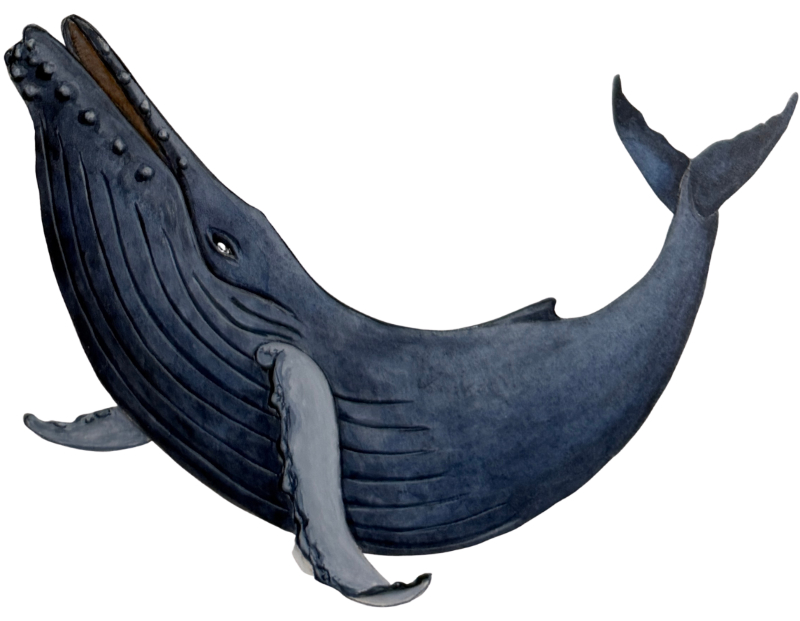
Humpback Whale
(up to 60’/18m)
Megaptera novaeangliae
Status: Endangered
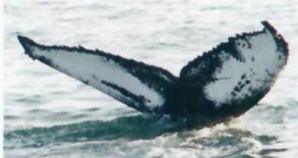
Humpbacks are easily recognized by their long, white flippers, variable shaped dorsal fins and unique black and white patterns on the tail Flukes. These patterns identify individual whales. Humpback whales feed in Cape Cod waters spring, summer and fall before migrating to the West Indian and Caribbean breeding grounds.
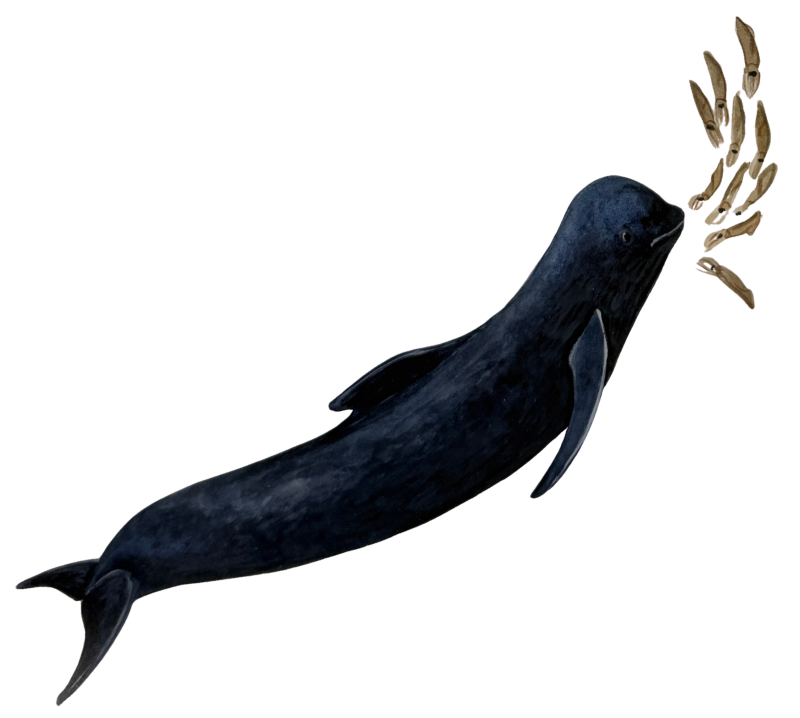
Long-finned Pilot Whale
(up to 20°/6m)
Globicephala melas
Status: Protected
The long-finned pilot whale is more likely seen in near shore waters during fall and winter when squid is abundant. Known for mass strandings on Cape Cod during winter pilots are seen in groups or pods of a few to over 50 individuals.
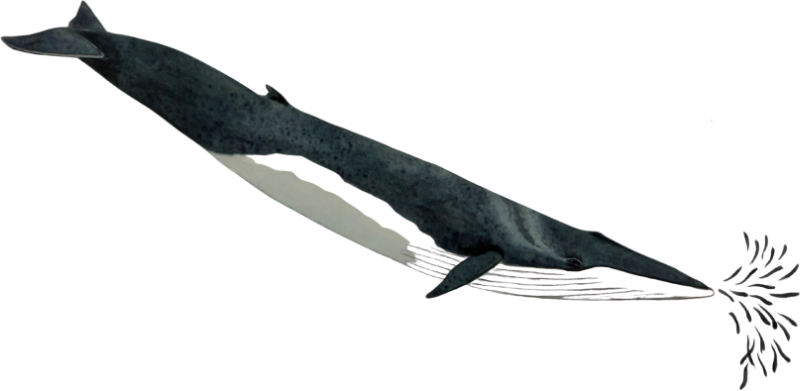
Finback Whale
(up to 90’/27m)
Balaenoptera physalus
Status: Endangered
Long, streamlined and fast moving, Finback whales are the second largest animal on earth. Their coloration is unique having a white lower jaw and swirls of color on the right side and darker coloration on the left.
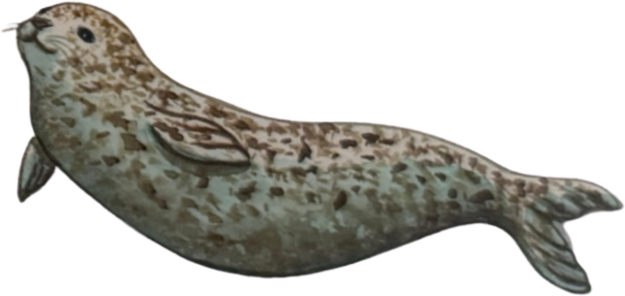
Harbor Seal
(up to 5/1.5m)
Phoca vitulina
The most common seal in Cape Cod waters, the harbor seal can be seen basking on sandbars during low tide. They generally feed alone, biting onto individual prey. They are the most highly adapted to water and easily visible when on the surface.

Northern Gannets
(wing span up to 6’/1.8m)
Sula bassana
Largest seabird commonly sighted off Cape Cod. Immature birds are seen in our waters during the summer; mature gannets during spring and fall. Best known for its spectacular plunge diving, hovering and then plunging towards the water with wings folded.

Harbor Porpoise
(up to 6’/1.8m)
Phocoena phocoena
Status: Protected
One of the smallest of all cetaceans, the harbor porpoise is commonly seen in near shore waters during early spring. Appear to be evasive towards vessels and are not easily seen. Like dolphins, the harbor porpoise grasps its small prey with its teeth.
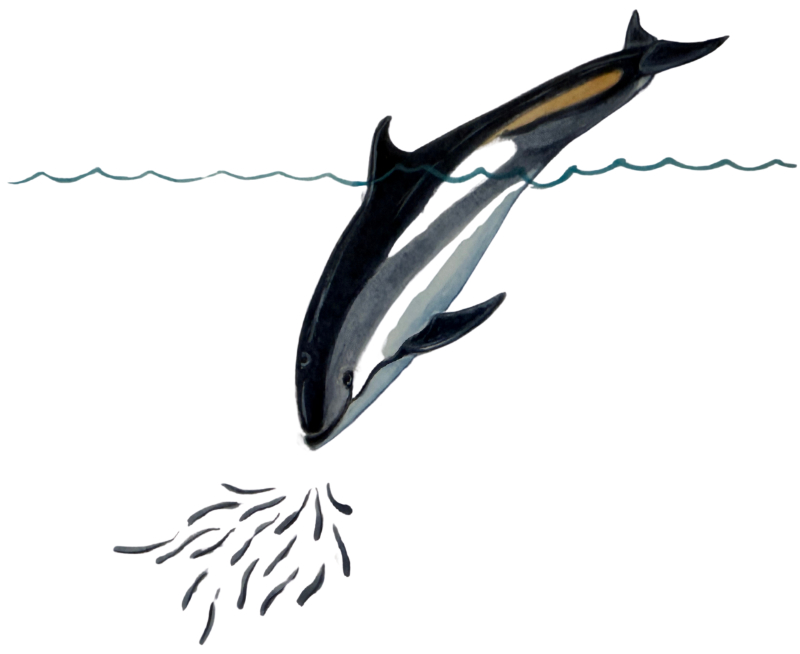
Atlantic White-sided Dolphin
(up to 9’/2.7m)
Lagenorhynchus acutus
Status: Protected
Seen in groups (or pods) from offshore waters to near shore, white-sided dolphins are the most common toothed whale seen in Cape Cod waters. They use their teeth to grasp small fish and often feed cooperatively in groups.
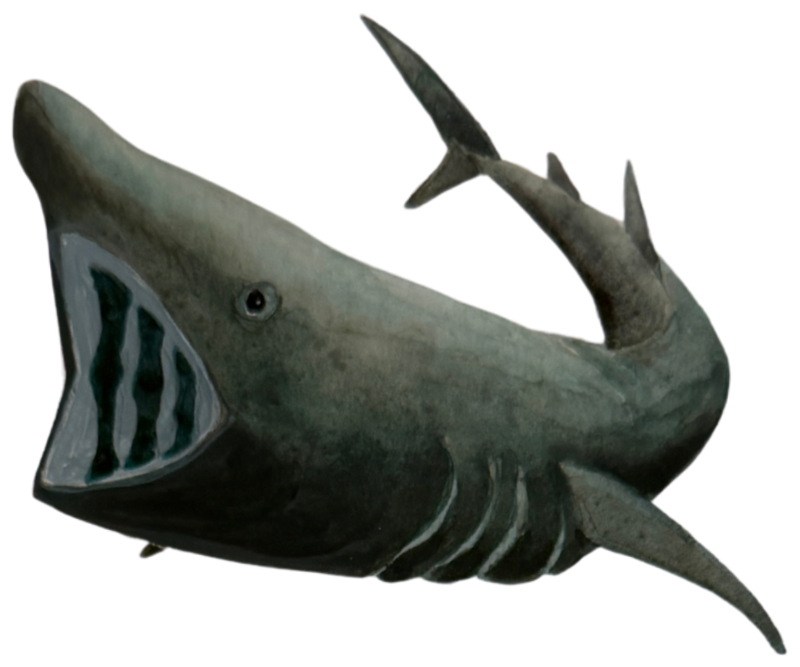
Basking Sharks
(up to 45/14m)
Cetorhinus maximus
Second in size only to the whale shark, the basking shark is easily identified by its large size and floppy dorsal fin. Basking sharks are seen commonly during summer months. Like right whales, basking sharks Feed on animal plankton by grazing, mouth open, filtering its prey from the water through modified gills.

Minke Whale
(up to 30/9m)
Balaenoptera acutorostrata
Status: Protected
Smallest of the baleen whales in Cape waters, the small, streamlined, fast moving Minke often is difficult to see. They have a white band on their flippers and a pointed jaw. Minkes are commercially hunted in the North Atlantic, North Pacific and the Southern Ocean.

Wilson's Storm Petrel
(wing span up to 16″/41cm)
Oceanites oceanicus
Small plankton and crustacean feeders with a moth-like wing beat, storm petrels migrate to our waters each spring from Antarctica. Thousands can be seen off Cape Cod during spring, summer and fall.

Ocean Sunfish
(up to 11’/3.3m)
Mola mola
Large, oval-shaped and odd in appearance, the ocean sunfish looks like a whale whose tail has been chopped off. Commonly seen in the summer, with its tall, triangular dorsal fin above the water’s surface, the sunfish feeds on jellyfish and comb jellies.
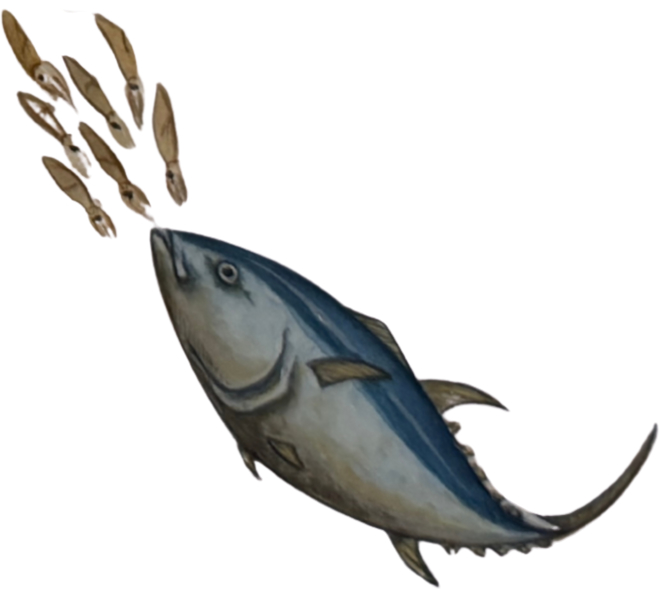
Bluefin Tuna
(up to 9’/2.7m)
Thunnus thynnus
Fast and robust, bluefins are the largest of the bony fishes and one
of the most highly prized by fishermen. Highly migratory, large schools of bluefins can be seen off Cape Cod during summer and fall. They feed on small fish including mackerel and herring.
FROM WHALING TO WHALE WATCHING
Provincetown Whaling
Native Americans were the first whalers of Cape Cod, using the whale’s meat, oil and bone. Early European settlers learned from the natives. The settlers harvested whales that washed ashore and ventured out to hunt them in Cape Cod waters. By the late 1700’s the North Atlantic right whale, a seasonal resident of Cape Cod Bay, was virtually extinct, and crews had to go further offshore to find whales.
In 1760, Provincetown had a fleet of a dozen whaling ships. As whaling came of age in New England, Provincetown suddenly transitioned from a quiet fishing village to a bustling seaport. By the mid-1800’s, Provincetown’s large and safe harbor became one of the busiest harbors in the country and the fifth largest whaling port with fifty-six wharves and a fleet of over 700 vessels. Whaling declined at the turn of the century and a storm known as the Portland Gale destroyed many of the wharves. The era of Provincetown’s fame as a major seaport had ended. The harpoons and guns were replaced many years later by cameras, binoculars and a new generation of seafarers-whale watchers.
East Coast Whale Watching
For years, Captain Al Avellar observed his deep sea fishing passengers exchange fishing rods for cameras to watch whales that swam nearby. He realized that if avid fishermen were interested in watching whales, it also might appeal to the general public. In April of 1975, Captain Avellar sailed the Dolphin III from Provincetown Harbor on its first whale watching cruise. East coast whale watching was born, and, as a result of Captain Avellar’s vision, Provincetown has become one of the major whale watching ports in the world. Since 1975, the Dolphin Fleet has remained within the Avellar family, and maintained his high shipboard standards, experienced captains and is world-renowned for its ongoing education and science programs.
One of the unique and exclusive advantages of whale watching with the Dolphin Fleet is that on every cruise there is a trained, experienced naturalist and educator. Since the beginning, researchers and naturalists have been educating passengers while collecting important scientific information on whales. They offer a program of total immersion into the marine ecosystem of Cape Cod and Massachusetts Bays and the Stellwagen Bank National Marine Sanctuary. The Dolphin Fleet continually works with the United States Coast Guard, the National Marine Fisheries Service, scientists and non-governmental organizations to promote the protection and conservation of whales and our shared marine resource.
THE STELLWAGEN BANK NATIONAL MARINE SANCTUARY
Stellwagen Bank National Marine Sanctuary is one of our nation’s precious ocean treasures and lies just north of Provincetown, MA. Designated by Congress in 1992, the sanctuary is one of only 14 sites deemed to be of such special national significance. The sanctuary is renown among the world’s premier whale watching destinations and is characterized by a remarkable array of ocean
resources.

Located near major population centers, the sanctuary attracts marine scientists, educators, recreational enthusiasts and commercial users. It is a repository of historic shipwrecks, including the side paddle- wheel steamship Portland, commonly referred to as “New England’s Titanic.” Among its most well known species are humpback and right whales, northern lobsters, Atlantic cod and bluefin tuna.
Virtually the size of the state of Rhode Island, the sanctuary includes the submerged lands of Stellwagen Bank, all of Tillies Bank and Basin, and the southern portions of Jeffrey’s Ledge. The Stellwagen Bank National Marine Sanctuary protects 842-square-miles of open water and the diverse seafloor beneath, created some 14,000 years ago during the retreat of the last Great Ice Age.
Today, whales swim where mastodons once trod, and a wide variety of marine mammals, seabirds, fishes and invertebrates make the diverse habitats of the sanctuary their home. Enjoy your shipboard excursion to New England’s only national marine sanctuary, and visit it virtually from home or office at the sanctuary website http:// stellwagen.noaa.gov.
NON-LETHAL RESEARCH
During the first 70 years of the last century, over 2 million great whales were killed by commercial hunts in the Southern Ocean alone. It is a staggering figure.
Years ago, scientists studied whales onboard whaling vessels, recording detailed information on whales taken (called scientific whaling or lethal research). At the time, it was the only approach available. Today, other approaches exist (called non-lethal research) to help us understand whales. Science is not a justification for hunting.
We have now, at least in many countries, replaced guns and harpoons with cameras, binoculars, hydrophones (underwater microphones) and genetic research. Meeting the whales and studying them in-and as part of-their ocean environment has greatly advanced our knowledge of their lives and needs. These landmark studies are non-lethal and in many cases cost effective.
Perhaps the most exciting approach to whale research has been individual recognition. As with chimps, elephants and other terrestrial species, we can identify individual whales by their natural markings, genetic markers and acoustic signatures. Through studies spanning up to 30 years of identifying individual whales, we have begun to understand entire species.
Such information collected from whale watch vessels can provide scientists with a cost effective, reliable means of studying whales while providing the general public with accurate information about whales and the marine environment. In return, data on individual whales are collected, analyzed and lay a foundation for answers to basic biological questions How old do whales live to be? At what age are they sexually mature? And how many calves can they produce in their life time?
When scientists exchange information on a species regionally or internationally, answers to questions of habitat use, migration and distribution become clearer. These collaborations clearly demonstrate that the use of benign, non-lethal techniques such as photo-identification have clear advantages over scientific whaling.
By sailing on the Dolphin Fleet, you are supporting non-lethal research to help promote the protection and conservation of whales and the marine environment.
IDENTIFYING INDIVIDUAL WHALES
Each one of our fingers has a unique print that can be a whirl, loop or arch. It is ours for life and will not change unless injured. Like our fingerprints, natural markings can be used to identify individual whales.
Giraffe
No humpback tails are alike and range in unique patterns from all white to all black.

Salt
The variable shaped dorsal fin may also be used to identify individuals. Distinctive patterns and marks are used in naming individual humpbacks.
Other types of whales are identified by natural marks on different parts of their body.

Blue Whales
by mottled patterns on their sides.
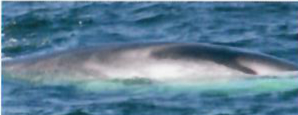
Finback Whales
by a swirl of color on their right side.
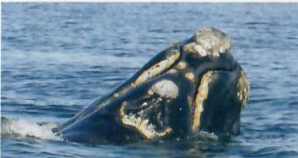
Right Whales
by distinctive patterns on their heads from rough patches of skin called callosities.
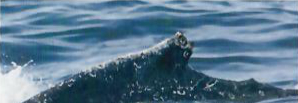
Scars
also can be used to identify individual whales and help us to understand the threats that they face.
CONSERVATION
As we head towards shore and leave the Sanctuary, it is important to remember the open beauty of the area and the dynamic and fragile web of life it supports. Each day, marine life and the marine environment face a series of threats, each one serious in its own right. While pollution (from chemicals and emissions), ocean noise (e.g. vessels, seismic tests, military sonar), entanglements in fishing gear, ship strikes and whaling pose threats to whales and their environment, the cumulative impact of these threats is potentially devastating.
Several groups around the world are working actively to address these threats and make our oceans a safer, cleaner place for all. They cannot do this without your help. Each one of us can make a difference. To learn more about these issues and campaigns and how you can help, log-on to the websites listed below.
Cetacean Society International
Natural Resources Defense Council
Whale and Dolphin Conservation Society
World Society for the Protection of Animals